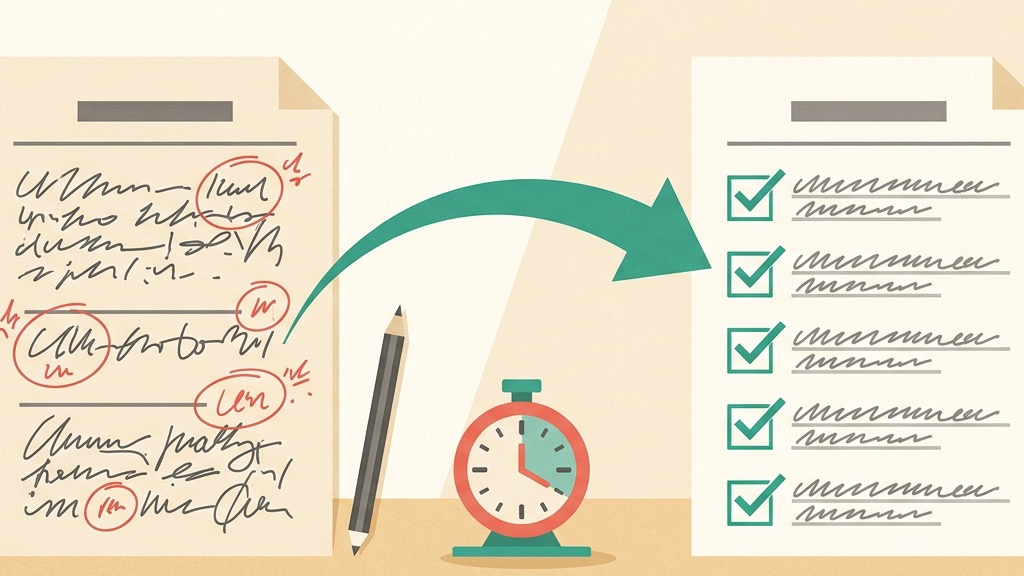
The wrong answers you were most confident about are the ones you are most likely to fix. That sounds backwards. Every theory of memory says a strongly believed answer should be the hardest to overwrite, and yet across dozens of laboratory studies the opposite keeps happening: errors made with high confidence are corrected more reliably than errors made with a shrug, and the correction sticks even when the retest comes much later. Researchers call it the hypercorrection effect.
Which means a graded test with red marks on it is not evidence of failure. It is the most precisely targeted study material you will ever own, a list of exactly what your brain is currently wrong about, sorted by how much the correction will surprise you. And most of it goes into a backpack, face down, unread.
Here is the 20-minute protocol I give every student I tutor for the day a test comes back. It turns that page of red marks into the best study session of the unit.
Why redoing beats restudying
The instinct after a bad test is to reread the chapter, which treats the test as a verdict instead of as information. The research points the other way. Janet Metcalfe's review of the field, Learning from Errors in the Annual Review of Psychology, concludes that making errors and then engaging with corrective feedback beats error-avoidant studying for neurologically typical students. The errors are not the damage. Ignoring them is.
The same review describes a finding that should sting a little. When researchers videotaped eighth-grade math classrooms across the United States, Taiwan, China, and Japan, the American pattern was procedures rehearsed and errors passed over without discussion, while the Japanese pattern was students attempting problems before being taught, followed by extended class discussion of the errors themselves: why each one was plausible, and where it left the road. Japan's math results speak for themselves. The 20-minute redo is that discussion, run by you, for an audience of one.
The protocol, minute by minute
Minutes 0 to 2: rate before you look
Go through the test and mark every wrong answer with one of two labels: "I was sure" or "I was guessing". Do this before reading any solutions or comments. This step feels pointless and is the most important one, because of the hypercorrection effect from the top of this article: the "I was sure" pile is where the biggest, most durable corrections live. Those are not your embarrassing mistakes. They are your highest-value ones, and they go first.
Minutes 2 to 10: find the line, name the kind
For each wrong answer, find the exact line where your work left the road. Not "I got question 4 wrong", but "line three is where the sign flipped". If the test only shows a wrong final answer and no feedback, you can usually locate the bad line yourself by checking the answer against the original problem and working backwards from where the check fails.
Then give each mistake one of four names:
- Slip. You knew the method and fumbled one operation. Take : the correct move is , giving , but under time pressure a hand writes and sails on to . One dropped multiplication, full marks lost.
- Procedure error. You picked the right method and executed a step you never actually mastered, the same way, every time. Slips are random; procedure errors repeat.
- Concept error. You used a method that does not apply, or answered a different question than the one asked because the underlying idea is fuzzy.
- Misread. The math is fine; the problem you solved is not the problem on the page.
The names matter because the fixes differ. Slips call for a checking habit, not more studying. Procedure errors call for drilling that one step. Concept errors call for going back to the explanation. Misreads call for underlining what the question asks before solving. Eight minutes of this and you know which of four different students you were on test day.
Minutes 10 to 16: redo from scratch
Clean paper, no notes, no looking at your old work. Redo every wrong problem in full, starting from the printed question. Copying corrections onto the test page does not count; the point is to make your hand produce the whole correct path once, because recognizing a fix and being able to generate it are different skills and only one of them is on the next test.
One caution from the research: make it your errors you study. In memory experiments, generating your own wrong answer before getting the correct one helped later recall, while being handed someone else's wrong answer hurt it. Trading tests with a friend to study each other's mistakes sounds efficient and points the wrong way. Their errors are noise to you; yours are the signal.
Minutes 16 to 20: explain the correct reasoning
For your two or three worst problems, write one sentence answering not "what is the right answer" but "why is the right method the right method". The phrasing comes from a study by psychologist Robert Siegler, described in Metcalfe's review, that compared three kinds of feedback with children: feedback alone, asking kids to explain their own reasoning, and, strongest of all, asking them to explain the correct reasoning, prompted with "how do you think I knew that?" Explaining why the correct path works forces the deep pass that copying a correction never does.
This is also the step where a solver earns its keep honestly. Run the problem through the equation solver on MathSolver, read the steps next to your redo, and make yourself narrate the one step your test version got wrong. You are not outsourcing the work; you already did the work. You are auditing it.
Do it the day the test comes back
Timing is not a detail. Reviews of feedback research found that what actually determines whether feedback helps is whether the learner pays attention to it, and attention is exactly what decays. The day a test comes back, you still care what question 4 was worth and why your answer died. Two weeks later it is a piece of paper about a unit that is over. Twenty minutes at peak attention beats two hours at none.
A note for the students I tutor who hate this exercise, which at first is all of them: some mistakes on your list will turn out not to be knowledge gaps at all, but route choices that multiplied your chances of slipping. A fraction-heavy solve that could have stayed in whole numbers is the classic case, and it is why picking the method with the smaller error surface is itself a learnable skill. The redo is where you notice that pattern about yourself.
Keep the list. It compounds.
Do not throw away the page where you named your four kinds of mistakes. Three or four tests in, that running list is a personal error profile no textbook can sell you: maybe 70 percent slips and misreads, which changes how you spend the night before a test far more than another hour of content review would. It slots directly into the front end of a three-day study plan, where your first session should start from exactly this list rather than from page one of the chapter.
And when the list tells you which topics keep biting, MathSolver's practice quizzes let you generate fresh problems on just that topic at the difficulty you choose, free and without an account, so the redo session can end with two clean reps on the exact skill that failed. Twenty minutes, once per test. It is the cheapest grade improvement I know of.