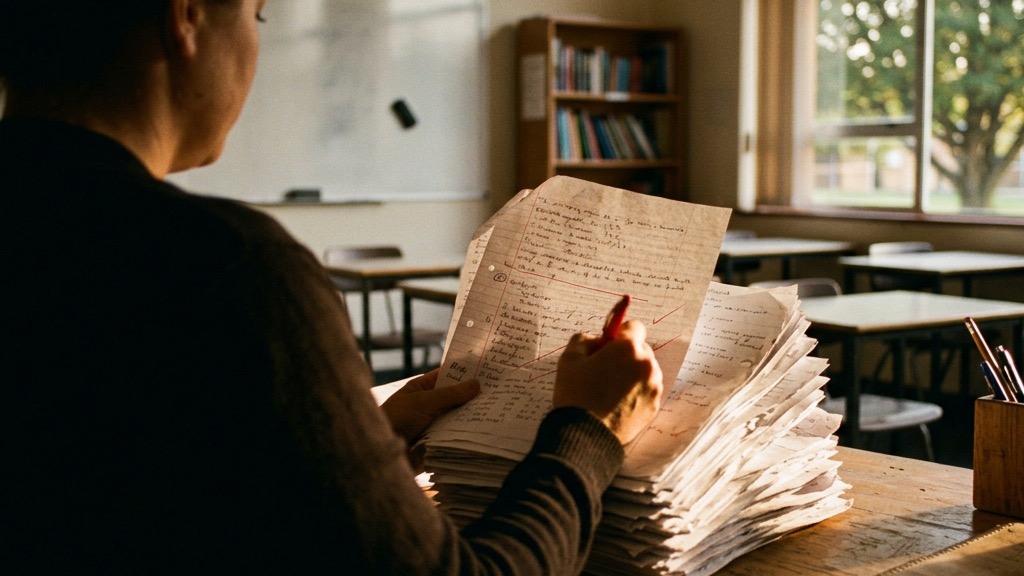
Not from the app. From the paper.
There is no detector for handwritten maths. No scanner reads your working and reports back. The solver apps do not send anything to your school, and they could not identify you if they wanted to. On the technical question, the answer really is no.
That is a smaller comfort than it sounds, because none of the students I caught over the years were caught by software. They were caught by their own homework, and usually within about four seconds of me picking it up.
The apps genuinely do report nothing
This is worth establishing properly rather than assuming, because students hear a lot of vague warnings about it.
Photomath, now owned by Google, has no teacher dashboard and no usage reporting. Its own documentation for teachers is about classroom use, not surveillance. And when Forbes asked the company directly about students using it to complete homework, a representative speaking for Photomath put it about as plainly as a company can: "There is no absolute way to know what a student is looking at when they're using the tool."
So the app is not the leak. You are.
What actually gives students away
When teachers describe catching this, they describe the same handful of tells. These are from named maths teachers in an account published by the California Teachers Association, and they will be familiar to anyone who has marked a stack of algebra.
The numbers are absurd. Joline Martinez of Yosemite High School noticed that her students "were solving problems with ridiculous fractions." Not wrong, necessarily. Just not the numbers that come out of the method the class was using. A solver will happily carry an exact fraction through six lines where the taught method clears the denominator on line one.
The method was never taught. Martinez again: her students "were using steps they had never been taught." This is the big one, and there is a reason it happens so reliably. Photomath's own help pages acknowledge that its solutions may not match your classroom, noting that its mathematicians try to cover many possible methods but keep only the most commonly used ones, and inviting users who "have learned a different method" to get in touch. The app is not trying to imitate your teacher. It has no idea who your teacher is.
The steps are compressed. Maggie Strode of South Hills High School saw students "combining several steps into one while solving equations," and noted that this was "something I do not have my students do." A tidy three-line solution in a class that has been drilled to show eight lines is not impressive. It is conspicuous.
The work just looks different. Layout, notation, the order operations are performed in. Every class develops a house style without anyone deciding to, and work produced outside that style reads as foreign even before you can say why.
Notice what all four have in common. None of them is evidence of an app. Each is evidence of a gap between the work and the student, and a teacher who marks thirty of these a night is reading for exactly that.
The tell that has nothing to do with your handwriting
The strongest signal is not on the page at all. It is the distance between your homework and your test scores.
Northern Illinois University's teaching centre describes the symptom in one line in its guidance on assessing maths in the AI era: "polished homework submissions paired with shaky quiz and exam performance." No individual assignment triggers this. The pattern does, over weeks, and it is very hard to explain away.
And the pattern is not a suspicion, it is measurable. An MIT study of homework copying used online submission logs and found that students who copied more than 30 percent of their homework problems had over three times the failure rate of everyone else. Copying algebraic problems specifically corresponded to about two letter grades worse on similar problems in the final exam.
Which means the homework-to-test gap is not really a detection method. It is the consequence, and detection is just a side effect of it.
Online homework is a different situation entirely
Everything above is about paper. If your homework is submitted through a platform, the platform keeps timestamps, and timestamps are evidence in a way that handwriting never is.
The MIT researchers' detection rule was simply this: when the elapsed time was too short for an average student to read the problem and enter the answers, they counted it as copied. No clever technology, just arithmetic on a log file.
A 2022 learning-analytics study took the same idea to scale, analysing over 82 million student submissions across 700 maths exercises. It found submission speeds shifting measurably over the years as photo solver apps spread, with the change concentrated in exactly the exercise types those apps handle well. Nobody had to catch anyone. The timing distribution showed it.
The four-second version
Everything above takes a teacher some effort. This does not.
Strode's method for confirming a suspicion was to sit the student down and ask them to solve a similar problem. Her description of what happened: "they didn't have a clue."
That is the entire test, and it is unanswerable. You cannot argue with it, because nothing is being alleged. You are simply being asked to do the thing your homework says you can do.
What teachers actually do about it
Here is the part that surprises students, and it was true in my own classroom too. Catching it rarely leads to punishment.
From the same California Educator account: Martinez said "I didn't really push the issue. I didn't want to have to contact all of the parents." Karin Prasad of Heritage High School gave students the chance to resubmit, saying "students were going through a lot." Strode's position was simply "I'd rather they not turn in an assignment than turn in work they didn't do."
What changes is not the consequences for you. It is the structure of the course. Homework gets reweighted towards completion rather than correctness, or dropped to a small slice of the grade. Marks migrate to in-class work that cannot be photographed. Assignments start demanding process evidence instead of answers.
So the homework you copied stops being worth anything, and the assessment that decides your grade moves to a room where you are on your own. Nobody accused you. The floor just quietly moved.
The thing worth actually worrying about
Pew Research found that 26 percent of US teens have used ChatGPT for schoolwork, twice the share of two years before. Buried in the same survey is a more interesting split. Asked whether using it to solve maths problems was acceptable, 29 percent said yes. Asked about writing an essay, only 18 percent did. Teens judge maths help far more permissively than essay help, and honestly? I get it. Checking a maths answer does feel different from having something written for you.
But the MIT numbers are the ones to sit with. Three times the failure rate. Two letter grades. Those students were not punished for copying. They just could not do it in November, and the homework had told them they could.
The line between using a solver well and using it badly is not about getting caught, and I have written separately about where that line actually sits. The short version is that the solver has to come after your attempt, not instead of it. Read the steps, close the page, and redo the problem blind. If you can, you learned something. If you cannot, you now know that before the test does.
That last part is the whole trick, and it costs about ninety seconds per problem. Work one through a full step-by-step solution and then reproduce it on a blank page, and the difference between the two attempts is the most honest report on your understanding you will get from anywhere.